I know little about motor cars. For years I have been sure car salesmen recognise me as a sucker as soon as I step into their showrooms. That may be why I bought an Austin 1800 whilst I lived in Benghazi in the middle of the last century. The Austin 1800 was designed by Sir Alex Issigonis who was responsible for the popular and successful Minni, a car which is now manufactured by Germans. The Austin agent in Benghazi offered me a discount on the grounds that I would be driving it regularly to the oil ports around the Gulf of Sirte. In doing so, he reasoned, I would demonstrate what a fine automobile it was. He had no Austin 1800s in stock so made great play of ordering one especially for me from UK. Sadly, when the vehicle arrived in his premises the discount he offered me was paltry. I should have smelt a rat and left the car with him.
My work often involved helping visiting British businessmen, journalist, archaeologists and so on. Sometimes they elected to join me when I visited the oil ports around the Gulf of Sirte or the remains of ancient Greek cities in the Jebel Akdar. It was a long time ago, but I clearly recall that the English visitor I was taking with me on one of my visits to the oil terminal at Marsa Brega was on a fact-finding tour for the Birmingham Chamber of Commerce.
There are a few matters I would ask you to take into account. The first is that the Austin 1800 was not a reliable vehicle. The second is that the distance between Benghazi to Marsa Brega is around 150 miles across the Red Plain and the White Plain both of which are politely called arid and, in those days, there were few wells and no fuel stops until you got to Ajdabia. The road was in bad condition. The potholes were numerous and large.
At the time the UK motor industry was experiencing industrial unrest. One well publicised industrial action was the ‘shoddy job’ protest when workers were apparently persuaded by their trade union leaders to be deliberately careless with their work on an occasional car as it passed through their hands on the assembly line. It was a ploy the unions deployed to unsettle the management. It may have been ‘fake news’ but it spread rapidly overseas. It made me angry because my life often depended on the reliability of the vehicle I drove.
We, the Chamber of Commerce man and I, had driven a good way into the Red Plain. A large lone cloud was moving across our route trailing rain. There were no other vehicles, camels, donkeys of humans in sight. I thought it would be a good time to address my guest about the difficulties we British were experiencing when trying to sell our country’s exports in Libya.
I cannot remember my exact words, but I am sure I explained that there was no water, other than the rain, or fuel available for about 50 miles. There were not likely to be many others on the road to help us if our vehicle broke down. Even if someone appeared, they may have been aggressively inclined towards us.
I remember asking him to go home to Birmingham and tell the worthies of his Chamber of Commerce what it felt like to be in an unreliable British made motor car in the middle of a desert.
Who would knowingly purchase and drive a car over the Red Plain, or any other similar terrain, which might have been one of the deliberately shoddy jobs? I think I made my point effectively and the Chamber of Commerce man kindly refrained from asking me why I had bought and Austin 1800.
RECKLESS, CRUEL AND PROFLIGATE MEN?
Walt Watson is probably dead by now. He was my neighbor in Tripoli. He was an American ‘ace TV reporter’ who had, amongst other adventures, accompanied Marilyn Munro on her tour of US military bases throughout Japan and South Korea. He was absent from his apartment in Garden City for a while. But when he reappeared, he told me he had been sent to the Belgian Congo because the US State Department had got wind of a potential attempt to remove the colonialists by force. Belgians were doing their utmost to get across the border to Kenya and safety. It was the first zephyr of what British Prime Minister Harold Macmillan referred to as the ‘Wind of Change’ which became something of a gale for a while.
Some days later I was on duty at the RAF staging post a few miles south of Tripoli when several military aircraft arrived from the UK, India, Italy and Canada. They were on their way to the Congo to rescue Belgian colonists who were fleeing the attention of rioters wielding their machetes with intent to butcher white people. One of the aircraft returned carrying some passengers. Also on board were three wooden packing crates over which had been draped blue UN flags. The crates contained mutilated bodies of nuns. There was a high demand for and a consequent shortage of coffins in Leopoldville. Long ago King Leopold’s men had set a cruel precedent which the rioters emulated with enthusiasm.
The Congo descended rapidly into bloody chaos and attracted several retired British Army men as mercenaries. One of their leaders became known as ‘Mad Mike’ Hoare. He was a retired British Army major and his mercenary exploits in the Congo inspired a performance by the noted film star Richard Burton in the 1978 film ‘Wild Geese’. There is a tension amongst the military between the need for disciplined and cooperative behaviour and unorthodox heroism, The latter trait was exhibited often by the super-mercenary Vice Admiral Lord Cochrane who served in wars of independence with the Chilean, Brazilian and Greek navies whilst he was at odds with the British establishment between 1818 and 1825. Mercenaries are interesting people and sometimes used as state proxies. The Russian Wagner group was Putin’s proxy army in Libya, and it helped him establish a profitable foothold in the Mediterranean and the Sahil.
There was a famous, and notably unorthodox, mercenary who operated in Fiji in the early days of the 19th century. He was Charlie Savage and his story, repeated as it is in many histories of Fiji, may be true in parts. He used his skill with firearms to support the ambitions of the chief of a warlike federation which was centred on the island of Bau, near the Rewa River estuary in Fiji’s largest island, Viti Levu. Missionaries have strong moral convictions which causes them to make unfavourable judgements about the likes of Charlie Savage. However, they provided us with the first written history of Fiji, so we need to keep this in mind when reading the first mention of him in their reports.
So, we pick up the story in the reports of Christian missionaries Thomas Williams et al who were active in Fiji after Savage ended his career somewhat abruptly by being killed, cooked and consumed. There was a tendency amongst British colonialists to criticise their fellow countrymen who go native as did Charlie Savage. There is an early mention in print of Charlie Savage in ‘Fiji and the Fijians’ by the sometime missionaries, Williams, James, Calvert, Rowe and Stringer.
‘’About 1804 a number of convicts escaped from New South Wales and settled amongst the [Fiji] islands. Within two or three years there were twenty of them: reckless, cruel, profligate men, whose muskets made them a terror to the enemies of their patrons; they lived by violence and the safe slaughter of savages armed only with primitive weapons; their reward was unrestrained licence, and their morals were that of a poultry yard.
Some of them were men of the most desperate wickedness, being regarded as monsters even by the ferocious cannibals with whom they were associated. These lawless men were twenty-seven in number on their arrival but in a few years the greater part had ended their careers, having fallen in the native wars, or in deadly quarrels amongst themselves.
A Swede named Savage who had some redeeming traits in his character, was acknowledged as the head man by the whites who was drowned and eaten by the natives at Weilea, in 1813’’
The language the missionaries use leaves us in no doubt that both the ferocious cannibals and the monstrous mercenaries needed the attention of the missionaries to repent of their sins and convert to Christianity. They did convert Fijians and precipitated the end of cannibalism, child culling and widow strangling. The missionaries do not say how these lawless men reached Fiji from Australia, but they do make a special case for ‘A Swede named Savage’. The majority of the ‘reckless, cruel, profligate men’ arrived in Fiji on merchant ships which were seeking cargoes of sandalwood.
Charlie Savage, who may have been Swedish, had arrived in Fiji from Tonga in an unorthodox manner. There are reliable sources who suggests that he had been a survivor of the armed brig ‘Port au Prince’ which had hit a reef off Tonga. His reputed skills as a marksman and fighting soldier, akin perhaps to those of the British Royal Marines, give credence to the claim.
Sailors with experience of ‘muskets and cannons’ were sought after crew members of ships owned and operated by merchant adventurers which carried ‘Letters of Marque’, as did the Port au Prince. She was a vessel with a doubtful history having at one time been employed in the transatlantic slave trade. She is recorded as an English private ship of near 500 tons armed with 24 cannons and 8 carronades. She was thus armed and authorised, by virtue of the ‘Letter of Marque’ to capture or sink French and Spanish vessels. Preferably capture because she could put a prize crew aboard, sail them to a port ‘within the King’s dominion’ and sell them to the prize commissionaires.
England was at war with Napoleon’s France which is why the British Admiralty was issuing ‘Letters of Marque’ to armed merchantmen. The United States also issued Letters of Marque at this time and was engaged in an early form of Gun Boat Diplomacy in the Sandwich Island and Fiji.
Holders of Letters of Marque were known as Privateers. They were supposed to operate within the law. Owners were required to register their ship with the British Admiralty and to stand security for the sum of £1500. In return They could tackle and seize vessel and cargoes belonging to France and Spain.
The Port au Prince had been busy whaling and sealing and had dropped anchor off Tonga when she was boarded and looted by Tongans who may have failed to take the considerable treasure in gold coins she had aboard. The wreck has been located by divers recently. They may be hoping that some of the gold she carried is still amongst the decaying timbers.
The Tongans killed about half of her 60 odd crew and burnt her down to the waterline. Was Savage one of the survivors? From the evidence now available it seems very likely. He certainly found his way to Tonga and is said to have learned to speak Tongan
How did Savage get from Tonga to Fiji? By a remarkable series of chances. His story is bound up in that of an American brig called Eliza which came to grief on a reef as she was on her way to secure a cargo of cedarwood in Fiji. It is akin to that of a shipwreck with which I had some dealings in last century. My story may help us to see how he reached the island of Bau, the seat of a powerful War lord, and find employment there as mercenary.
Navigating amongst the Fiji Islands is hazardous because of the extensive reefs which are at the same time amongst its precious assets. This is an anecdote I wrote in my own diary sometime after leaving Fiji.
SHIPWRECK ON A REEF WITH DIAMONDS
Sometime in the dead of night I received a telephone call from a senior personage in the trading company for which I worked in Fiji. I am not sure why it was me he called but I did have the experience to deal with his problem. He told me that the company’s ship, the SS Lakemba, on its way from Suva to Sydney, was shipwrecked on a reef. The SS Lakemba was an old-fashioned cargo and passenger ship which had long tramped her way from Vancouver to Sydney and back via Hawaii, Western Samoa, and Fiji. She had reached the end of her honourable life and was to be paid off when she arrived in Sidney. Now she was about to die. My caller told me a rescue ship was on its way to save the passengers and crew who would be coming ashore in due course. What, he wanted to know, could I do about it?
I had dealt with similar events in Libya. It was easy to tell him to set about chartering an aircraft to take them to Sidney and to arrange hotel rooms for them in Suva whilst we waited for the rescue ship to arrive. He asked me to see if a suitable aircraft would be available whilst he conferred with his superiors. I called Qantas and they had a Boeing 707 in Sidney we could use for a price. The ship’s owners agreed to charter it and instructed me to do so and to make the other arrangements to get the passengers from the dockside in Suva to Sidney as smoothly and quickly as possible. By the time the rescue ship, the Cable and Wireless vessel ‘Retriever’, arrived alongside Suva docks we had staff, accommodation and ground transport ready. We had also chartered Fiji Airways to fly the passengers from Suva to the international airport at Nadi to meet the Qantas charter: interesting but not exiting.
It was the consummate seamanship of the captain and crew of the CS Retriever which saved one hundred and fifty survivors four of whom were in their eighties. The captain of the SS Lakemba had kept her engines going and the propellers turning until the rescue had been all but completed. Soon after they were stopped the ship fell off the reef into deep water. It was, as they say, beyond salvage.
When the rescue ship docked, I went aboard with a representative of the wreck’s owners. I found the rescued passengers in a saloon. They were venting their frustration in emphatic terms. I stood on a chair and explained the arrangements I had made. This cheered them up somewhat. I waited with the owner’s representative at the foot of the gangway as they disembarked. A somewhat distraught passenger engaged us in conversation. This is the gist of his story in so far as I remember it.
He had joined the ship in Vancouver intending to emigrate to Australia. He arranged for his camper van to be loaded aboard as deck cargo. He would use it to travel around Australia looking for a place to settle. The camper van had, of course, gone down with the ship. He added that he had invested his savings in diamonds. He had concealed them in the bodywork of his camper van and been unable to retrieve them before he was rescued.
The Fiji reefs are spectacular. I hope that Global Warming is not killing them.
They had a terminal effect on the American brig Eliza which was on her way to collect a cargo of Sandalwood from the southwest coast of Vanua Levu, Fiji’s second largest island, but was off course by a goodly margin. She was off the Island of Nairai in the Lomaviti archipelago when she hit a reef. According to the dairy of one of her crew members this occurred:
‘’On the 20th of June 1808, being in S. lat. 17, 40, E. Long 179, at about eleven o’clock p.m. the man who had the lookout on the forecastle, seeing breakers but just ahead, cried out “with the greatest vehemence, and gave us the alarm. I then was sick in my bunk below, but with the others, I jumped out, but before we could get on deck the vessel struck on the rocks. We caught the axe and cut away the rigging and the masts went over the side, and as they fell broke our whaleboat in pieces, but we got the long boat out and put the money in it to the amount of 34000 dollars, the navigating implements, muskets, a cask of powder and balls, cutlasses and some of our clothes: we also lashed two canoes together, and John Husk and William Brown went on board of them to keep them astern of the long boat and heading the seas, while mase[sic] the rest of us went into the long boat. Our fears were great that, if the vessel went to pieces, we should be killed……’’
Where had the brig been? On the 1st of May 1808 the Eliza had set sail from Port Jackson in Australia and twelve days later arrived in Tonga. It was there that two survivors of the Port au Prince were living. They both persuaded the Captain of Eliza to take them on as experienced and useful crew members. One was called Charlie Savage who was to become a notable figure in the history and folklore of Fiji.
Somehow Savage travelled the considerable distance from Nairai and wreck of the Eliza to the Island of Ba where the War Lord was aggressively striving to become the paramount chief of Fiji. Legend has it that whilst he was on Nairai a ‘canoe’ voyaging from Bau stopped at the island and recruited him as the War Lord’s ‘white mercenary’. We know nothing of the inducements offered but we know that he took several muskets and quantities of powder and ball with him. The Fiji Times published an interview with his decedents living in Fiji today. They claim the news of Savage’s presence had reached the Paramount Chief of Bau, Ratu Naulivou, who sent the ‘canoe’ to offer him employment.
Historians sum all this up by saying that the brig Eliza brought the musket and Charlie Savage and thus changed the nature of warfare in Fiji. Some say that Charlie Savage and his muskets propelled the Cakobau dynasty to the paramount chieftainship of Fiji but that is too simplistic. However, the muskets alone would have made a notable difference because the Fijian weapons of war were only effective for skirmishing. They were mainly bows and arrows, spears and clubs. Before a battled there was a great deal of posturing and threatening and once everyone was sufficiently motivated, close order fighting began resulting in a few casualties. If possible, each side would try to carry off their dead otherwise they would be butchered, cooked and consumed by their enemies. These intense motivational events have persisted in the Thimbi. Today the superb New Zealand Rugby teams perform the Haka to terrify their opponents before the starter’s whistle. The Fijian Rugby team perform a similar war dance called a Cibi. The Fijians pronounce that ‘Thimbi’, a name which understates its power to intimidate opponents.
We have become almost inured to the sight on our TV screens of large numbers of deaths and numerous casualties in the burgeoning warfare of the early days of this century. But it was possible to survive the wounds inflicted by spears and clubs. A lead ball shot at short range from a musket by comparison caused severe and often fatal wounds. A good marksman could pick out and kill Chiefs and leaders who died as if by magic, creating confusion and panic. When they were first used in Fiji, they were psychologically damaging. Today we find combatants are getting used to drones but in their early days they created panic on the front line.
However. There was a fundamental limitation with muskets. They took time to load. Modern films based on Bernard Cornwall’s novels about the character he calls Sharp who ‘fought’ in the Peninsular battles of the war against Napoleon have shown how this was done and how crack soldiers who did it well were sought after. British infantrymen who were drilled in their use and could manage three shots a minute starting with their weapons already loaded. Charlie Savage is said to have been highly effective with them. This is how he is perceived in Fiji today. It is part of a piece in the Fiji Times dated 11th January 2015:
‘It was a sight completely alien to the Bau people. A strange white skinned man with red hair and beard was being accorded rites and ceremony normally befitting a great warrior, more-so, one of their own. Many Bauan natives had never seen a white man before, except that Kalle Svensson aka Charlie Savage, was no ordinary kaivalagi (white) man.
The giant Swede single-handedly turned the tide of war in Fiji when Bauan warlord, Naulivou, was determined to overwhelm his enemies and stamp his dominance throughout the land. But Savage’s influence would grow and legend has it that the sons he had by high ranking women, given to him in marriage, would be killed to prevent anyone usurping the chiefly leadership at Bau’.
Often repeated stories about Savage are still circulated. Foremost amongst them has him standing in a canoe on the Rewa River firing his muskets at the people of a village. He kills so many villagers that their dead bodies are built up in a wall behind which survivors sheltered.
The other and most likely story is that he had a ‘arrow proof sedan chair’ made of coconut fibre and other vegetation in which he sat with some preloaded muskets and was carried into range of his enemies. So protected, he fired though an opening, cooly picking out leaders who fell dead as though by magic.
He was specially treated by then War Lord of Bau and given a highborn woman as a wife. That led to trouble in the end because his son by her would have had some claim to the War Lord’s place when he died. His was therefore killed. Savage had other wives with whom he had children. His descendants are living in Fiji under the name of Shaw. Their story appeared in the Fiji Times dated May 29th, 2017.
Savage himself was killed when attempting to rescue some of the crew of a merchantman who had been recruited by a War Lord to settle a dispute which became a shooting war. They had become surrounded and were in mortal, danger. Savage offered to negotiate with their besiegers. He approached them unarmed. A fatal mistake. His head was held under water in a convenient pond until he drowned and then, it seems, they butchered him, cooked him and ate him.
One small point to make. He is often referred to as being Swedish. He may have been. The claim needs more evidence in my view.
The Hakluyt Society published ‘The Journal of William Lockerby – Sandalwood Trader in the Fijian Islands 1808-1809’. In it the Journal is preceded by a diligent and scholarly analyses of the arrival of white men among the Fijian Islands and observations on their effect on the social system they encountered and which they changed or, as one critic has said, mutilated by 1840. There are now numerous scholarly papers and publications analysing the effect of ‘colonialism’ on the plight of native Fijians and the Indo-Fijians who live now under the military government of Rear Admiral Bananarama.
There are other factors to considered. The Fiji Islands were long isolated behind the extensive coral reefs. They are still, as I have shown, dangerous to unwary mariners and were more so in the days of sail. In Tahiti the arrival the HMS Bounty was greeted by canoes bearing welcoming men and women. No such welcome was offered when ships arrived amongst the Fiji Islands. There, the women were absent and the men often menacing. The story of the mutiny on HMS Bounty is being scrutinised carefully and new conclusions drawn. There are crucial differences between the arrival of Whiteman in Tahiti and Fiji.
Those early sailing brigs which penetrated the Fijian reefs and fetched up in Sandalwood Bay loaded their holds and bilges with the valuable wood. They were privateers which were crewed by men who were educated in the ways and means of rope and sail, musket and cannon and used to living in close and sparse quarters under the rule of hard driving masters. Notably they lived for long periods without women. However, they expected a share of the profits and were volunteers not pressed men.
Some of these men were left behind or were put ashore as troublemakers or were survivors of wrecks. They were recruited by the War Lords engaged in internecine warfare and favoured with status and women, sometimes with high borne woman, with whom they had numerous children.
The warfare and the influence of these white men helped to catalyse the mutation of Fiji’s ancient social system. They were followed by Christian missionaries of which more annon.
John Oakes
24th December 2024
HIGH WIND IN CYRENIACA
I was visiting an oil terminal on the Libyan shore of the Gulf of Sirte. The wind was fierce and coming from the east. It was not a Ghibli – the wind Libyans call what Egyptian’s call the Khamsin. That would have been coming from the south and would have been uncomfortably hot and carrying fine sand from the Libyan desert. This wind was cold and coming from the east and carried grains of local sand which stung when they hit exposed parts of humans. It was the windblown sand which erodes soft rocks and strips paint jobs off motor cars.
As I watched, the wind blew a large ship from its moorings out in the Gulf of Sirte where it had been filling its copious tanks with crude oil. It was drifting helplessly toward the shore. An anchor cable had entangled itself in its propellers. The great vessel was pulled away from danger by the Dutch ocean-going tug which was always on standby near the oil terminal.
I finished my work and headed home in my car along the coast road. I was driving into the wind. It was blowing sand which was blasting against the car and abrading it. Camels walked towards me with their legs immersed in the blown sand and their rider perched in clear air. An empty and anomalous cardboard box flew past me a meter or so above the ground. It remained elevated by the wind as I watched it come towards me and as it vanished behind me. Here and there, Libyan men sat wrapped in their Jards with their backs hunched against the wind. These Jards were Toga like woollen blankets draped about the body in traditional fashion. They could also be used as a tent, a blanket, or a windshield.
The road turned northeast at Ajdabiya and crossed the White Plain and the Red Plain and in both the terrain changed. The main hazard here was the tumbleweed rolling across the plains and across the road. There were very few settlements along the road and no water wells. If sand had seized up my car engine, I would have been in troubled. I recall my growing anxiety.
I got home to our villa in a sheltering olive grove in a suburb of Benghazi. The sump of my car had been polished to a high shine by the sand blast. I took it to the garage the next day. The engineers found sand in the engine. I was lucky.

THE GAUNTLET
I wonder now about the casual brutality meted out to migrants in Libya by the people traffickers. Or the political or religious fervour which allows for the extermination of so many human beings. Where does it come from? I do not mean the collateral damage caused by bombs and artillery which is bad enough. I mean the casual killing such as Boko Haram’s mad men carry out in villages and towns in Northern Nigeria or Chad. They do that in the name of God.
My headmaster used the cane with intent to hurt. He beat me across my fingertips for crimes I committed downstairs and across the buttocks for those I committed upstairs in the dormitories. I was beaten most often for failing a test or once for persistently misspelling the word went. I added an h to make it whent so that it was spelt the way my mother pronounced it when putting on airs.
There was a tradition amongst we boys about not showing pain when we were caned. Was I a mug to try to keep that tradition? He had caned my fingertips once and complained because I showed no pain, so he caned me again. I still showed no pain and he left with his academic gown bellowing out behind him. He would play Mozart on his upright piano after school before falling asleep on the settee in his rooms.
Sometimes the bigger boys beat the smaller boys with army webbing belts or wooden coat hangers. This was gratuitous beating and more akin to the Boko Harem killings because some boys would enjoy their work. They did not need instructions from an avenging deity. They were experimenting with sadism perhaps.
In the dormitories the ordeal of the knotted towels was called running the gauntlet. Small naked boys ran between two lines of big boys who swung towels at their backs with knots tied at one end. The knots were better and had a more satisfactory impact if the towel had been soaked in water for a while.
OUR FARM VERSUS ADOLF HITLER
We were a farming family of four, but our numbers had been temporally augmented by relatives seeking refuge from the German blitz on nearby Coventry. With grandparents, aunts, and uncles we were transfixed by a huge armada of German aircraft flying in successive waves over our Warwickshire farmhouse one night in November 1940.
We had gathered in the kitchen, our all-purpose room. It was lit by oil lamps and heated by an ancient cooking range. Our blackout curtains were carefully closed so that the air-raid warden would not embarrass us by shouting ‘put that light out’. Our windowpanes were firmly taped to prevent glass shards flying about in the event of a bomb blast.
The massed bombers of Hitler’s Luftwaffe always made a distinctive sound. Numerous bombers contributed to it that night. There had been sixteen or so raids on Coventry since the war began and the bombers had flown over our house on every occasion. Familiarity had given us as false sense of security and our farm was some miles from Hitler’s target. Perhaps that is why we were unmoved by the high-pitched noise of a bomb passing over our roof.
I have wondered how it was that a German crewman released a bomb that night to whistle over our farmhouse and landed in one of our fields. The explosion it made sent us diving for cover under our big mahogany table. The dutiful and diligent airmen of Lufftflottt 3 had been sent to burn the city of Coventry not to disturb the cattle on an English dairy farm. Their codename for the raid was ‘Mondscheinsonate’. We did not know this, otherwise we may have found the irony provoking.
The air crews would have armed their bombs and opened the bomb doors before they flew over our house on their approach to the waiting city. A mechanical failure in one aircraft must have released ‘our’ bomb. By good fortune it had enough forward momentum to clear our house and land in a field mercifully free of livestock. It did, however, cause several cows in an adjacent field to abort their calves.
Coventry’s meagre defences were easily breached. Many wondered why and some still do. So, the Germans flyers bombed Coventry – and us – on the night of 14th November 1940. Some sources suggest that they killed some 380 people and injured 850. Only one German aircraft was confirmed as destroyed.
When it was light enough, we went to look at our bomb crater. It was a small and clearly caused by an incendiary bomb. A strange, innocent looking metal artefact remained undamaged in the fresh soil. No one could work out what it was. It could well have been part of the bomb’s attachment to the aircraft and thus account for its premature release.
The raid was intended to break Britain’s resolve and cause her leaders to sue for peace. Instead, it encouraged an escalation of mutual destruction leading inexorably to Dresden, Hiroshima, and Nagasaki.
Not long ago my sister and I talked about how we climbed from under the protection of our big mahogany table and watched the firestorm light up the sky over Coventry. She remembered, as did I, that one of the aircraft was caught for a while in a searchlight’s beam. I had begun to think my vivid memory of the event could have been false. Our accounts, however, matched substantially. Long after the war my sister died in her adopted hometown in Germany.
GOONY BIRDS GET YOU THERE
Goony Bird was a name given to the large and apparently goofy Albatross by American servicemen on Medway Island in WWII. The name became attached, again by US servicemen, to the DC3. This was a type of aircraft which first flew in 1935 – the year I was born. In its guise as the C-47 Skytrain by the Americans or the Dakota by the R.A.F it carted freight and passengers about during WWII. DC3s were still carrying freight and passengers around when I was living in Libya and later in Papua New Guinea.
For a while I caught the regular DC3 flight from Benghazi to Marsa Brega on Friday mornings and back to Benghazi on Friday evenings. Approaching Benghazi in a DC3 of an evening you would see the whole city below you as the aircraft made a tight turn to line up with the airstrip. The white salt pans stood out as did the inner lake where the flamingos fed, and the mosquitoes bred and sent squadrons of their kind at night to disturb our sleep. You could see the floating crane moored by the sailing club in the harbour and my bitumen pipeline on the big breakwater. The Cornice stretched its way from the British embassy to the dock gates and in the old Italian town, the cathedral and the venerable Berenice Hotel remained behind after the Italians had long departed.
The ‘Goony Bird’ was recruited into service by civil airlines across the world. Sometime in the 1960’s I had been a burden on the hospitality of East African Airways in Nairobi who were not paying me quickly enough. I suspect they booked me on a day safari to the Serengeti so that they could get a little rest. It may have been the reason I joined a group of tourists heading for Tanganika in a DC3.
We disembarked by a Landrover and a lorry somewhere in the great expanse of the Serengeti’s grassland, and I joined the queue of my fellow passengers filing past a gentleman with whom we all shook hands. The man was Louis B Leakey the paleoanthropologist who needed the money from we tourists to finance his work in the Olduvai Gorge and to help support the notable research by Jane Goody, Birutė Mary Galdikas and Dian Fossey on primate behaviour.
A few years later the Goony Bird played a part in my short career in Papua New Guinea. It flew freight and passengers where roads were impossible and airstrips short.
My wife, our daughter and I thumbed a lift on a DC3 loaded with building supplies from Lae to Mount Hagen. There were only two seats, so our daughter sat on a pile of ‘fibro’. The airport for Mt Hagen – Kagamunga – is at an altitude of 5,400 ft. To get from Lae to Mount Hagen the Goony Bird gained height to top the Owen Stanley range. As it did so we saw the cloud waterfall rolling off the mountain. I believe this phenomenon is known as orthographic clouds.
Later in New Guinea I thought I had hired a DC3 to take tourists on a day trip from Lae to Woodlark, one of the Trobriand Islands some way off the east coast of New Guinea. The DC3 failed to show, and the tourists were less than pleased and clamoured as only angry Australians can for a refund.
If you are a student of sociology, you may well have come across Bronislaw Malinowski the founding father, so it is said, of anthropology. He lived as what is called a participant-observer in the Trobriand Islands when WWI was raging in Europe. He developed the notion that the main function of religion was to help individuals and society deal with the emotional stresses which occur during life crises. More relevant to my frustrated prospective tourists in Lae, he also made some interesting observations about the sex lives of Trobriand Island ladies.
After a long life and many mistakes, the failure of the DC3 to turn up at Lae recurs in my memory at inconvenient times. Especially at dawn in England’s deep midwinter.
FLYING HOME TO BERKA II IN A GOONEY BIRD
Sometimes the oil company let me fly in the DC3s they hired to carry people between the old WWII airfield near Benghazi to and from the airstrip near their oil terminal at Marsa Brega on the southern shore of the Gulf of Sirte. I would go there to meet British expatriate workers who wanted to fly to UK and back by East African Airways for their regular home leave.
We would do our days’ work around the oil terminal and make the trip home in the old veteran aircraft in the late afternoon. It could be hot, and the humidity could climb to make you sweat so fine dust would stick to you.
To make his approach to the old potholed airstrip the captain would make a steep turn over Benghazi city. You could look down from your seat and watch the wing tip pointing at the city and the flat calm sea. Sharply in focus for a while were the white salt pans, the huddled old city, the cathedral dome, and the flat calm harbour with the ramshackle floating crane tied up near the sailing club. The silted inner harbour always had a small flock of pink flamingos feeding in shallows.
CRAB CRAW SAILS AND FALSE MEMORY SYNDROME
I think I have seen a Lakatoi. A Lakatoi is a multihulled sailing raft powered by a Pacific crab clawed sails. Memory is difficult and you lose confidence in it, especially if you think you have seen something truly rare. False Memory Syndrome is not uncommon.
The one which is now vivid in my mind’s eye was sailing across the bay before the town of Port Moresby in Papua New Guinea. It was not one of the big Lakatois that sailed before the prevailing south east trade wind called the Laurabada from Hanuabada, the stilt village of the Motu people, westwards along the Papuan cost until they reached the villages near the Fly River estuary to trade clay pots for sago. These were great multi hulled rafts with two Pacific crab claw sails and many crewmen who formed a trading cooperative. The crews would stay a while, add more canoes to the raft and load up with dried sago. When the prevailing wind changed to the Lahara they ran their loaded Lakatois before it back to Hanuabada. Why did they do this? Because Hanuabada village, and nearby Port Moresby, lies in a rain shadow and sago palms and the big trees to make canoes will not grow there. There was a shortage of carbohydrate but the Hanuabada woman were skilled at making clay pots. There were plenty of sago palms and big trees to make canoes along the coast near the Fly river estuary complex. The Laurabada blew the pot laden Lakatois westwards and the Lahara blew them back again loaded with sago and bigger by a few canoes. It is what anthropologists, who love the story, call the Hiri trade cycle.
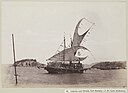
My Lakatoi was just a small one which looked like a raft with a hut on it and the great crab claw sail rising above it. The raft was made of wooden canoes lashed together and the sail of coconut matting. They must have been a hell of a job to sail. Long ago the Hiri trade was stopped because of the number of lives lost trying to sail the great Lakatois heavily loaded with sago.
The one I saw was heading in the direction of the other stilted village to the east of Port Moresby called Koki village. There is a painting of Koki village that June bought in the Top Pub in Port Moresby hanging on the wall in my home now.
THE WRATH OF THE THIRD MRS STEINBECK
I think it was a complaint that Mrs Steinbeck was making when she spoke to me. We were standing on the pavement outside my offices in Port Moresby, Papua New Guinea, from whence I had been summoned by her tour guide. Mr Steinbeck had delegated his wife to reprimand me whilst he remained in the back seat of his limousine. I think it was sometime in 1967.
The eminent author and his wife had been staying in Lae on the northern coast of New Guinea and had hired my travel company to guide them around its hinterland. The lady who ran the local office undertook the task. She had telephoned to warn me that the Steinbecks would be seeking me out to express their considerable dissatisfaction with her efforts. She, like many Australians, was not notably deferential when addressing important folk. It might have improved her attitude towards them had they not insisted he was John Steinbeck’s brother.
I believe Mr and Mrs Steinbeck had hoped for a period of rest and reflection in Papua New Guinea following a visit to the ill-fated war in Vietnam. He was said to have betrayed his principles by writing favourable reports about US engagement in the region. His wife was later to suggest that his experience in the war zone had led to a change of mind. He may have begun to question both its legitimacy and its execution whilst he was in Papua New Guinea.
The lady from Lae told me that Mr. Steinbeck had been very angry with her whilst she was driving him and the third Mrs Steinbeck to see the remains of the abandoned gold fields at Bulolo, some two and a half hours by road out of town. She told me that Mr Steinbeck had complained about back pain. The road from Lae to the gold fields was very rough indeed in those days and the off-road performance of contemporary motor vehicles was poor. He would have been shaken about somewhat. It is not surprising that he complained. Later, whilst in Japan on his way home, he was found to have two or three collapsed vertebrae. He underwent an operation in the USA to relive the paralysing pain this unfortunate condition causes. He died in December 1968 of heart disease exacerbated by heavy smoking.
I had not trained my Lae branch manager well enough in the business of tour guiding. She was a feisty lady who was prone to make dismissive remarks about native Papua New Guineans. Her attitude would have upset Mr Steinbeck who may have found parallels in the events in his own country where Martin Luther King was at the height of his powers. He may also have reflected on the sad history of Native Americans. To be fair, it took both Canada and New Zealand a long time to legislate for, and begin to effect, a more enlightened policy towards Native Canadians and Maoris. Such polices need concerted and determined action by governments. This was a not a benefit available to Native Papua New Guineans at the time.
The gold fields at Bulolo had played an important role in the relationship between Australia and Papua New Guinea though the wealth they generated was of little benefit to the latter. They were also notable because in the 1930s, in the absence of roads, eight 3,000-ton aero-portable gold dredges were flown into them from the port of Lae in one of the first major air lift operations in history.
The tourist industry was in its adolescence when the Steinbecks visited Papua New Guinea. The commercialisation of sacred ritual and custom was one of the dilemmas it faced then and still faces now. It is exemplified in the vicinity of Bulolo by the Anga tribe’s custom of preserving the corpses of their dead by smoking them slowly and ceremonially in a Spirit House. The dried human remains were smeared in red mud and left sitting on bamboo platforms on the mountain side overlooking their native villages. At least one of the sacred sites where some of these fragile remains are to be found is now included in tour itineraries. I believe the custom of smoke curing ceremonies has been resurrected recently. Christian missionaries had attempted to stop it in the early years of the twentieth century by offering the Anga supplies of salt with which to cure the corpses. They may have reasoned that it would reduce the ritual which attended the smoking method.
By the time I was summoned to speak to them the Steinbecks were spending a few days in Port Moresby before flying home to the USA, probably via Hong Kong and Japan. I do not recall much of the conversation with Mrs Steinbeck. I do remember the famous Noble Laurate glowering at me from the back seat of a limousine.
HOT FOOT TO HEAVEN OR HELL
I was in the Colonial War Memorial Hospital in Fiji for a good while. I had been severely injured in an accident and, I am told, near death at one time. I survived the immediate trauma and embarked on the long business of mending my body in what was called the Male Paying Ward because we who occupied it could afford the modest fees for our operations and care. The Fijian nurses set about mending my mind with unfailing humour.
My fellow patients came and went, some I fear to their respective heaven or hell depending on their religious preference. In which case the smiling nurses would cut the toenails of the corpses because they continue to grow a while. Sometimes relatives argued across the remains of their late kinsmen about unresolved family matters.
It was inevitable that we patients should talk about death in the circumstances. One of my Fijian neighbours in the ward had an interesting slant on the subject. He was from the island of Bega (pronounced Benga) where members of some families occasionally displayed their immunity to burns by psyching themselves up and dancing on very hot stones. Sadly, some canny folk realised that this might be a profitable tourist attraction so watching the Fire Walkers of Bega found its way onto ‘bucket lists’ along with swimming with dolphins and watching the wildebeest migration on the Serengeti.
My ward neighbour had walked barefooted for most of his life. When he was confined to a hospital bed for a long time the thick skin on his feet began to crack into deep and painful fissures. The famous Bega Fire Walkers may benefit from the extensive callouses on their feet.
He told me the story of the serpent god who lived in a cave in the Nakavada mountains in the interior of Viti Levu, the largest of Fiji’s numerous islands. When you die, he said, your soul journeys into the afterlife via the serpent’s cave where the scaly deity decides if it goes to heaven or hell. He was unable to tell me the criteria the serpent applied when making its decisions. Some modern religions offer more help in this regard by guaranteeing exclusive access to eternal paradise in return for obedience on earth.
TIME TO SELL THE CHILDREN
When drought hits the people of Northern Niger they often say, ‘it is time to sell the children’. Sometimes they do just that. It is little wonder that so many people of the Sahel now set out on the long and dangerous journey to Europe where the streets seem to be paved with gold. Many of them travel the old trans-Saharan slave trafficking routes through Libya.
There are few people writing about Libyan people trafficking with real experience of living there. Without that experience it is difficult for observers to understand the great distances and physical hazards migrants must overcome to reach the Mediterranean shore and embark on the hazardous sea crossing. Libya is a very large country much of which is inhospitable. I lived and worked there for more than eight years and drove my less than reliable British motor car over its roads. It was in the middle of the last century admittedly. Libya was just then emerging from being one of the poorest countries in the world into oil rich nationhood and Gaddafi was still training in the Royal Libyan Military Academy. Tribes still migrated with their flocks and telephone communication was sparse and intermittent. King Idris was still nominally in charge, but he was a reluctant monarch who attempted to abdicate at least twice whilst I was there.
I have not driven but have flown over some of the other countries the migrants traverse such as Chad and Niger. From the air the Libyan Desert and the Sahara look forbidding enough but the view through an aircraft widow is a privileged one and not shared by an impoverished migrant riding the roads and tracks in an overloaded Toyota half truck. We have no real data about the number who die on the land leg of their journey, but I suspect there are many. The simplest of the long road trips I made regularly was from Tripoli to Tobruk along the old military road constructed by the Italians when they occupied Libya. They built rest stations along the way but in my day, these had been abandoned. The last remnant of the Italian colonial way stations was Mamma Rosa’s bar at Ben Juade. Mamma Rosa’s daughter had acquired somewhat overrated popularity born of long periods of life without women amongst those who drove supplies to the oilrigs deep in the hinterland. At Mamma Rosa’s one could purchase a cold drink, admire her daughter, and watch camels replenish their capacious water storage organs at the drinking troughs.
The distance by road from Tripoli to Tobruk via Misrata, Sirte, Ajadabia, Benghazi and Derna is approximately 1,460 kilometres and the journey should take around 19 hours if you drive without stopping at Libya speeds. Few would attempt to do so, even today. The road was not in good repair in the middle years of the last century when I was travelling around Libya. On one notable occasion I was met and summarily forced off the road a few kilometres west of Ajadabia by a motor convoy conveying King Idris from Tripoli to Tobruk. The poor king, who was not in robust health, was so shaken up by the numerous potholes in the road that he caused them to be repaired by a Greek construction company. The Greeks succeeded in replacing the potholes with lumps which were almost as destructive. Land travel in Libya is hazardous for several reasons. Libyan drivers are rather reckless and are not keen on being overtaken. Wrecked cars are not uncommon, even on long strait roads.
Also, it gets very hot indeed during the day in the summer but the temperature dips steeply at night. High winds can make life very difficult. I drove through a gale whilst near Marsa Brega when the sand blast raised by the wind was so severe it stripped paint off the front of my car and polished its sump to a high shine. Water is not readily available, and dehydration can be lethal. Vehicles which overheat are not recommended. A real, but fortunately infrequent, hazard is the hot wind which rolls up from the deep south. These winds are known as Khamsins in Egypt. In Libya they are called Ghiblis, and they are formidable. The sight of a Ghibli as it approached me over the Red Plane west of Benghazi frightened me a great deal. These awful sandstorms suffocate one in dust. There is only one thing to do and that is to stop and sit it out in the hope that one does not dehydrate and that the motor engine will not have seized up with sand when the storm has passed.
I knew the city of Ajadabia well enough. I would stop there on my regular journeys from Benghazi to the developing oil ports on the shores of the Gulf of Sirte. I often ate a late breakfast in one of its cafes of a boiled egg and a cup of very strong and very sweet coffee, known in Libya as ‘Ghid Ghid’. So strong and addictive is ‘Ghid Ghid’ that it may account for the lack of harmony which besets Libya today! It is an interesting town. It has strategic value today because it is here that members of two major Libyan tribes, Al Magharba and Al Zuweya, live in a wary coexistence. The Magharba now exercises a great deal of influence over the oil terminals on the shores of the Gulf of Sirte and the Zuweya tribe’s homeland includes a major section of Libya’s oilfields. It is at Ajadabia that the coastal road from Tripoli now branches in three directions, one branch goes north east across the white and red plains to Benghazi, a second strikes out eastwards across the southern foothills of the Jebel Akhdar, roughly following the old Trig al Abd camel track to Tobruk, and a third takes the hazardous route going SSE in the direction of Kufra and, even further south, to the Jebal Uweinat.
This is one of the main roads for people trafficking. The distances are enormous. For example, the Jebal Uweinat is around 1,200 kilometres from Ajadabia. Ajadabia is now one of the northern hubs on the people trafficking routs from East Africa and the Horn of Africa via Khartoum and Dongola in the Sudan and Kufra in Libya’s Deep South. From Ajadabia traffickers often take their human cargo westwards to Tripoli to find the fragile and unstable boats in which they are packed to hazard the Mediterranean crossing to Lampedusa, Malta, Sicily, and mainland Italy. Kufra is an oasis town which is now Libya’s the southeastern hub for people trafficking. The route through Kufra to Ajadabia is favoured by refugees from Eritrea and Somalia. Data from the International Organization for Migration shows that these two countries are large contributors to the tide of human migration into Southern Europe.
Many of the young migrants from Eritrea appear to be escaping military conscription and Somalia has long been a failed state, a veritable model of anarchy. Recently a number of refugees from Syria have been using this route. They are escaping the Syrian misery and finding their way to Turkey from whence they fly to Khartoum and travel thence by land to Kufra. That would be complicated enough but they still have to get to the Mediterranean coast from Kufra and then make the parlous crossing to a European shore. It is a demonstration of the lengths human beings will go to find a future for themselves and their progeny. It is also a demonstration of the firestorm of warfare, religious intolerance, corruption, grinding poverty and racial hatred which blights a great swathe of the Middle East and Africa.
For those who make it as far as Kufra the journey to Europe would be hard enough, but Libya is a divided state and corruption is rampant. The people traffickers have growing ever more callous and brazen
Some Sudanese traffickers are taking their clients on a new route westward from Dongola and Khartoum to Quatrun and Sebha in the Libya’s Fezzan. Here the migrants from East Africa join those from the Sahel and West Africa who trek eastwards via Bamako in Mali and Naimy, Agadez and Dirku in Niger. This is the route followed by drug smugglers carrying their lethal mind-altering chemicals shipped into corrupt West African states by the South American drug cartels. A substantial number of the ‘western’ migrants originate in Mali, Nigeria, Senegal and the Gambia. Once in Quatrun the migrants face a 1057-kilometre road trip to Tripoli before they embark on the sea crossing to Lampedusa, Malta, Sicily or mainland Italy.
Libya is shouldering the blame for the tide of economic migrants attempting to cross the Mediterranean. There is no doubt that unscrupulous people traffickers are making money out of human misery. The migrants are following tracks made by their ancestors who were sold into slavery by unscrupulous Sultans in Darfur, Wadai and Kano and trafficked across the Sahara. Even today they may see the skeletons of those who were left to die for the desert is slow to recycle bones. The trans Saharan slave trade was still functioning until 1911.
It is time to question the resounding silence of the Heads of States from whose lands the tides of migrants have their origin. The present conflict in neighbouring Sudan has pushed large numbers of refugees to try to cross the border into Libya. Neither the Sudanese nor the Libyan authorities know how many have died attempting the journey, and many of those who survived are now trapped in limbo.
As long as it remains divided, Libya will be ill-equipped to cope with these sudden and unexpected migrant arrivals.
Today Libya hosts 40,540 refugees and asylum-seekers who are registered with UNHCR’

